Photo Gallery
9 Photos
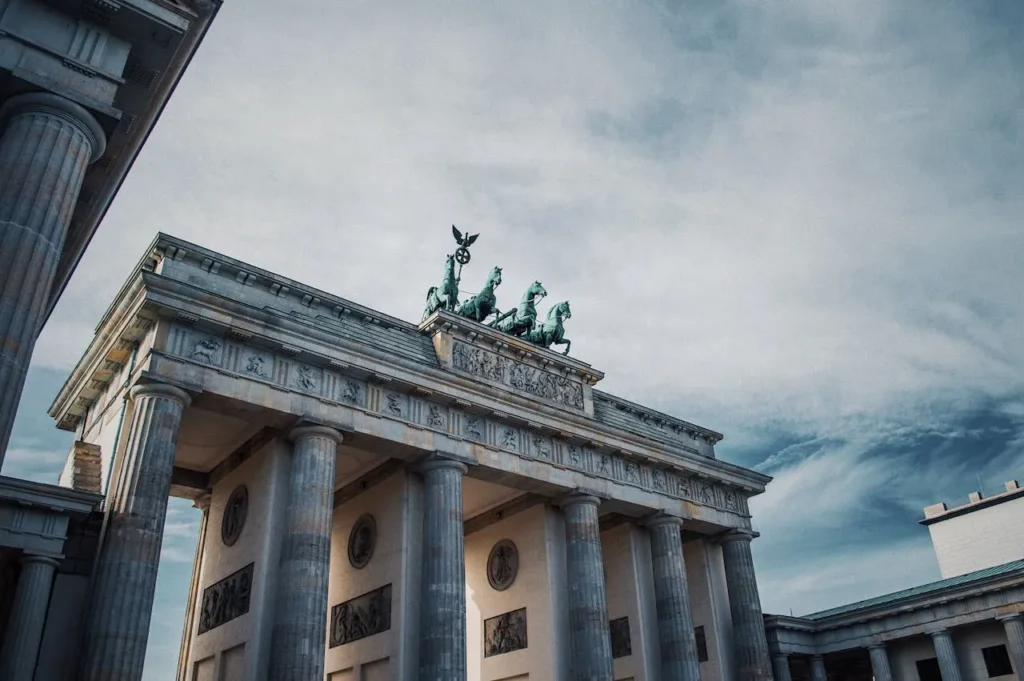


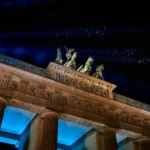
Click on any image to view in full size
About This Attraction
The Brandenburg Gate stands as Berlin’s most iconic landmark and one of Germany’s most recognizable monuments. Built from 1788 to 1791 by orders of King Frederick William II of Prussia, based on designs by the royal architect Carl Gotthard Langhans, this neoclassical triumphal arch was inspired by the Propylaea of the Athenian Acropolis. Rising 26 meters high and spanning 65.5 meters wide, the gate represents the pinnacle of Prussian neoclassical architecture and has become an enduring symbol of German history, unity, and resilience.
The gate is supported by twelve fluted Doric columns, six to each side, forming five passageways. Originally, only royalty could pass through the central archway, while common citizens used the outer passages. Two years after the Brandenburg Gate was completed, the so-called Quadriga—a chariot pulled by four horses and driven by Victoria, the Roman goddess of victory—was placed on the roof of the gate by sculptor Johann Gottfried Schadow in 1793. This magnificent copper sculpture stands 5 meters tall and weighs approximately 6 tons, becoming one of Berlin’s most photographed symbols.
The Brandenburg Gate has witnessed every major chapter of German history over the past two centuries. When Napoleon Bonaparte defeated Prussia at the Battle of Jena in 1806, he marched triumphantly through the gate and ordered the Quadriga removed to Paris as war booty. After Napoleon’s defeat in 1814, the sculpture was triumphantly returned to Berlin, and the iron cross was added to Victoria’s staff, transforming her into a symbol of Prussian military victory. This moment cemented the gate’s role as a national monument celebrating German pride and resilience.
During the 19th century, the Brandenburg Gate served as the ceremonial entrance to Unter den Linden, Berlin’s grand boulevard leading to the Royal Palace. Prussian kings and military parades passed through its archways celebrating victories and displaying imperial power. The gate became intrinsically linked to German nationalism and military glory, a symbolism that would take on darker meanings in the 20th century.
The Nazi regime transformed the Brandenburg Gate into a propaganda backdrop. Hitler’s torchlight parades passed beneath the Quadriga, and the gate featured prominently in Nazi imagery projecting power and supposed Aryan superiority. During World War II, Allied bombing severely damaged the gate—the Quadriga was destroyed, and the sandstone columns were riddled with bullet holes and shrapnel damage. By 1945, the gate stood as a broken monument amid the ruins of Berlin.
Post-war reconstruction began in 1956, with East and West Berlin cooperating to restore this shared symbol despite Cold War tensions. The Quadriga was recast using the original 18th-century molds, and damaged stonework was carefully repaired. However, the gate’s location would soon make it the most potent symbol of German division.
When the Berlin Wall went up on August 13, 1961, the Brandenburg Gate found itself in the death strip—the heavily fortified no-man’s-land between East and West Berlin. The gate stood in an exclusion zone in an arc of the Wall, inaccessible to locals and visitors from both sides. For 28 years, this symbol of Prussian victory and German culture became a haunting emblem of division, visible but unreachable, a powerful reminder of the Iron Curtain splitting Europe.
President Ronald Reagan delivered his famous “Tear down this wall!” speech near the Brandenburg Gate in 1987, with the monument serving as the dramatic backdrop for his challenge to Soviet leader Mikhail Gorbachev. Two years later, history answered that call.
When the Berlin Wall fell on November 9, 1989, the Brandenburg Gate became ground zero for celebrations. Over 100,000 people gathered here for the gate’s official reopening on December 22, 1989, climbing atop the Wall, dancing, singing, and celebrating reunification. The images of jubilant Berliners celebrating at the Brandenburg Gate broadcast worldwide, symbolizing the end of the Cold War and the triumph of freedom over oppression. The gate transformed overnight from a symbol of division into the ultimate symbol of German reunification and European unity.
The gate underwent extensive restoration from 2000 to 2002, repairing damage from decades of pollution, conflict, and celebration. The sandstone was carefully cleaned, structural weaknesses were addressed, and the Quadriga received conservation treatment. The restoration revealed original 18th-century paint colors and architectural details that had been obscured for centuries.
Today, the Brandenburg Gate serves as a powerful symbol of German reunification and European unity, attracting millions of visitors annually who come to admire its neoclassical architecture and reflect on its profound historical significance. The gate anchors Pariser Platz, one of Berlin’s most beautiful squares, which has been reconstructed with elegant buildings housing embassies, luxury hotels, and cultural institutions.
The gate serves as the focal point for major celebrations—New Year’s Eve draws over one million people to watch fireworks and concerts, the annual Berlin Marathon passes through its archways, and national celebrations regularly take place in its shadow. The Room of Silence, located in the north wing, offers visitors a quiet space for reflection and contemplation, acknowledging the gate’s role in both triumph and tragedy.
The Brandenburg Gate remains accessible 24 hours a day, completely free of charge, embodying Berlin’s commitment to openness and public space. At night, dramatic lighting transforms the gate into a glowing beacon visible across the city. Photographers flock here at sunrise when golden light bathes the sandstone columns, and at sunset when the western sky creates stunning silhouettes of the Quadriga.
The gate’s enduring power lies in its ability to embody seemingly contradictory meanings—Prussian militarism and peaceful unity, division and reconciliation, war and peace. Standing before the Brandenburg Gate, visitors connect with over 230 years of European history, from enlightenment ideals through nationalist fervor, totalitarian horror, Cold War division, and ultimately, reunification and hope. No single monument captures the complexity of German and European history quite like Berlin’s most beloved landmark.
Interesting Facts
Visitor Information
Opening Hours
Entrance Fee
Recommended Duration
Best Time to Visit
Address
Pariser Platz, 10117 Berlin, GermanyLocation & Map
Tip: Click and drag to explore the map, use scroll wheel to zoom in/out