
On December 14, 1900, a 42-year-old German theoretical physicist stood before the German Physical Society in Berlin and presented a paper that would fundamentally transform humanity’s understanding of reality. Max Planck’s introduction of the “quantum of action”—now known as Planck’s constant—marked the birth of quantum mechanics and initiated a scientific revolution that continues shaping technology and physics today.
Planck’s discovery emerged not from bold speculation but from desperate necessity. Wrestling with the black-body radiation problem that classical physics could not solve, he reluctantly introduced a radical idea: energy does not flow continuously but instead comes in discrete packets—quanta. This concept violated everything physicists believed about nature’s continuity, yet experimental evidence left no alternative.
Berlin served as the perfect setting for this revolution. The German capital’s University of Berlin attracted the world’s finest physicists, creating an intellectual environment where revolutionary ideas could emerge. Planck spent nearly four decades in Berlin as professor of theoretical physics, transforming the city into quantum theory’s birthplace and establishing himself as one of history’s most influential scientists.
This conservative, methodical physicist—who initially doubted his own revolutionary discovery—would receive the Nobel Prize in Physics in 1918 and see his name attached to Germany’s premier research organization, the Max Planck Society. His story intertwines personal tragedy with scientific triumph, unwavering principles with political turmoil, and cautious temperament with world-changing innovation.
Quick Facts:
- Born: April 23, 1858, in Kiel, Germany
- Historic Discovery: December 14, 1900, in Berlin
- Nobel Prize: Physics, 1918
- Planck’s Constant: h = 6.626 × 10⁻³⁴ joule-seconds
- Career: Professor at University of Berlin, 1889-1927
- Died: October 4, 1947, in Göttingen, Germany
EARLY LIFE AND EDUCATION
ACADEMIC FAMILY BACKGROUND
Max Karl Ernst Ludwig Planck was born April 23, 1858, in Kiel, Holstein, into a distinguished academic family. His father, Julius Wilhelm Planck, served as Professor of Constitutional Law at the University of Kiel. Both his grandfather and great-grandfather had been theology professors at Göttingen. This scholarly heritage instilled in young Max deep respect for intellectual rigor, honesty, and dedication to truth—values that would guide his entire life.
As the sixth child in a blended family (his father’s second marriage), Planck grew up in an environment that greatly respected scholarship, fairness, and generosity. When he was nine years old, his family moved to Munich after his father accepted a professorship there. Munich’s stimulating cultural environment profoundly influenced the boy, who developed passionate interests in both music and the natural sciences.
MUSICAL TALENT AND CAREER CHOICE
Planck possessed extraordinary musical gifts. He had perfect pitch and excelled as a pianist, composing songs and even a light opera. At Munich’s Maximilian Gymnasium, he seriously considered careers in classical philology, music, or physics. His music teacher encouraged him to pursue professional musicianship, recognizing exceptional talent.
Yet Planck chose physics after dispassionate self-assessment. He concluded that while he possessed musical ability, his greatest originality lay in scientific thinking. This rational career decision reflected Planck’s character: logical, methodical, guided by evidence rather than passion. Music remained integral to his life, however. Daily piano practice provided solace and joy throughout his career, with Schubert and Brahms compositions particular favorites.
UNIVERSITY STUDIES
In 1874, seventeen-year-old Planck entered the University of Munich. His physics professor, Philipp von Jolly, discouraged him from theoretical physics with a now-infamous warning: physics was “a highly developed, nearly fully matured science” that would “soon take its final stable form” after the recent discovery of energy conservation. Theoretical physics offered no future, Jolly argued.
Planck responded that he didn’t seek to discover new things but merely to understand the existing foundations of physics. This modest statement belied the revolutionary work to come. Under Jolly’s supervision, Planck conducted his only experimental work—studying hydrogen diffusion through heated platinum—before recognizing that theoretical physics suited him better.
Following German academic custom, Planck transferred to the University of Berlin in 1877 for a year of study. His teachers included Hermann von Helmholtz and Gustav Kirchhoff, two giants of 19th-century physics. Planck found Helmholtz unprepared and boring, while Kirchhoff delivered carefully prepared but dry, monotonous lectures. Ironically, Kirchhoff would later become Planck’s predecessor at Berlin, and Kirchhoff’s work on black-body radiation would directly inspire Planck’s quantum breakthrough.
Disappointed by formal instruction, Planck pursued independent study, reading extensively in thermodynamics—particularly Rudolf Clausius’s publications. The second law of thermodynamics captivated him, becoming the subject of his doctoral dissertation. He received his doctorate from Munich in July 1879 at age 21, launching his academic career.
THE BERLIN YEARS BEGIN
APPOINTMENT TO BERLIN
After completing his doctorate, Planck faced the typical struggles of young academics seeking positions. He worked as Privatdozent (unsalaried lecturer) in Munich from 1880 to 1885, then became Associate Professor of Theoretical Physics at Kiel until 1889. His career transformed dramatically when Gustav Kirchhoff died in October 1887.
The University of Berlin—Germany’s most prestigious university—sought a physicist to replace Kirchhoff. Despite Planck’s initial disappointing experience as a student there, Berlin’s Faculty of Philosophy proposed him for the position, with strong recommendation from Helmholtz. In 1889, age 31, Planck accepted appointment as Associate Professor at the University of Berlin. He was promoted to full Professor in 1892, a position he held until retirement in 1927.
Berlin in the late 19th century flourished as a scientific capital. The university attracted outstanding scholars, while research institutions like the Physikalisch-Technische Reichsanstalt (PTR) in Berlin-Charlottenburg conducted cutting-edge experimental work. This combination of theoretical brilliance and experimental precision created ideal conditions for scientific breakthroughs.
LIFE IN BERLIN
Planck thrived in Berlin’s intellectual atmosphere. His home became a gathering place for physicists, mathematicians, and scholars from various disciplines. He hosted regular musical evenings, playing piano while colleagues and students performed on other instruments. These salons blended science and culture, reflecting Planck’s belief in broad intellectual engagement.
Despite his growing prominence, Planck maintained modest habits. He took long daily walks regardless of weather, hiked in mountains during vacations, and climbed Alps even in advanced age. Physical activity complemented intellectual work, keeping mind and body balanced. Colleagues admired his discipline, punctuality, and unwavering work ethic.
In 1887, Planck had married Marie Merck, daughter of a Munich banker. They enjoyed a happy marriage that produced four children: sons Karl and Erwin, and twin daughters Margarete and Emma. Family life provided stability and joy during his early Berlin years, though tragedy would later shatter this happiness.
THE QUANTUM REVOLUTION
THE BLACK-BODY RADIATION PROBLEM
By the 1890s, a puzzle vexed physicists: the spectrum of radiation emitted by heated objects. Kirchhoff had defined “black bodies” as perfect absorbers and emitters of radiation. Understanding how black bodies radiated energy at different wavelengths (or frequencies) and temperatures seemed a fundamental physics problem.
Wilhelm Wien, Planck’s colleague at the Physikalisch-Technische Reichsanstalt, proposed an empirical formula in 1896 that worked well at high frequencies. Planck found Wien’s law theoretically attractive and attempted to derive it from thermodynamic principles—specifically the second law of thermodynamics, which Planck considered an absolute law of nature.
However, by October 1900, experimentalists Otto Lummer, Ernst Pringsheim, Heinrich Rubens, and Ferdinand Kurlbaum discovered that Wien’s law failed completely at low frequencies and high temperatures. Rubens visited Planck’s home on Sunday, October 7, 1900, sharing the latest experimental results over coffee and cake. That evening, Planck worked intensively to find a formula matching the new data.
THE DESPERATE ACT
By late evening October 7, Planck had discovered a mathematical formula—now called Planck’s radiation formula—that fit experimental data perfectly across all frequencies and temperatures. On October 19, 1900, he presented this formula to colleagues. It worked beautifully, but Planck didn’t understand why.
The next two months brought intense theoretical struggle. To derive his formula from first principles, Planck realized he must abandon cherished beliefs. He had to accept Ludwig Boltzmann’s statistical interpretation of the second law of thermodynamics rather than treating it as absolute. More shockingly, he had to assume that electromagnetic energy could be emitted and absorbed only in discrete amounts—quanta.
Planck later described this as “an act of desperation.” After years of effort, he reluctantly introduced energy quantization: E = hν, where E represents energy, ν (nu) is radiation frequency, and h is a new fundamental constant—Planck’s constant. Energy could only come in multiples of this elementary unit. The value Planck calculated, h = 6.55 × 10⁻²⁷ erg-seconds (modern value: 6.626 × 10⁻³⁴ joule-seconds), proved to be one of nature’s most fundamental constants.
DECEMBER 14, 1900: BIRTH OF QUANTUM THEORY
On December 14, 1900, Max Planck presented his complete theoretical derivation to the German Physical Society in Berlin. His paper, “On the Theory of the Energy Distribution Law of the Normal Spectrum,” introduced the quantum hypothesis to the world. This date marks the birth of quantum mechanics, though few recognized it then.
Planck himself viewed quantization as a mathematical trick rather than physical reality. He spent years attempting to reintegrate the quantum of action into classical theory, later writing: “My unavailing attempts to somehow reintegrate the action quantum into classical theory extended over several years and caused me much trouble.”
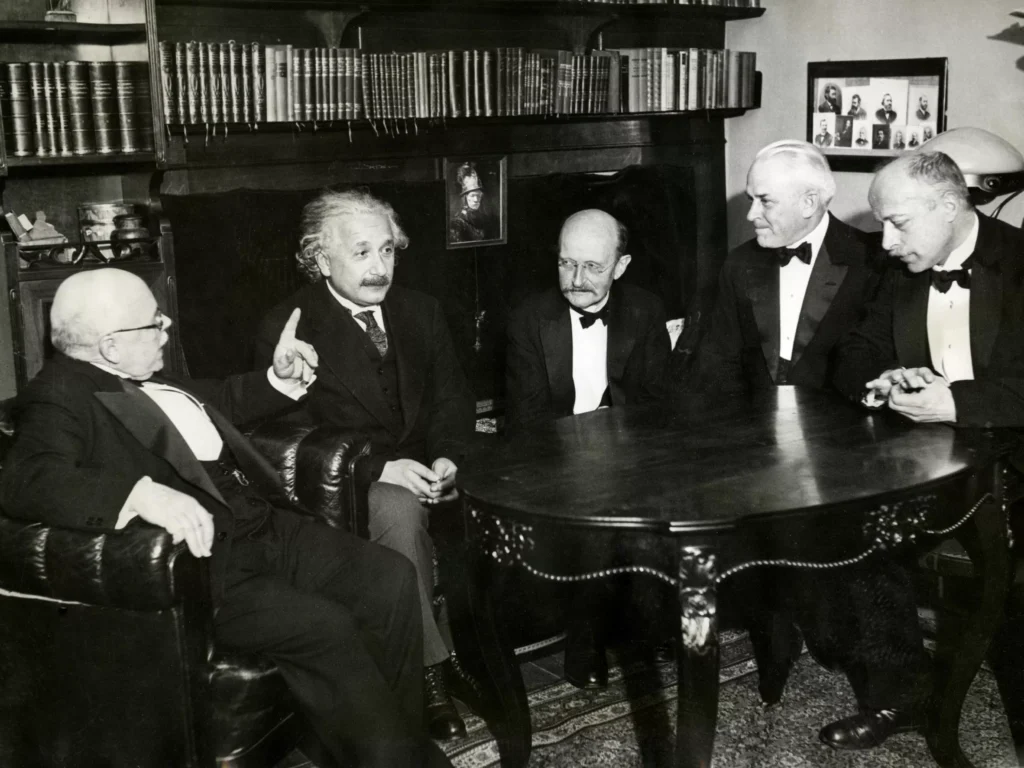
Other physicists initially resisted or ignored Planck’s work. Lord Rayleigh and James Jeans tried setting Planck’s constant to zero to restore classical physics. Only gradually did the scientific community recognize that Planck had discovered something fundamental about nature itself—that energy is inherently granular, not continuous.
THE QUANTUM CONCEPT TAKES HOLD
Albert Einstein provided crucial validation in 1905, applying Planck’s quantum hypothesis to explain the photoelectric effect. Einstein proposed that light itself comes in quanta (later called photons), extending Planck’s idea beyond emission and absorption to radiation’s fundamental nature. This work, for which Einstein would receive the 1923 Nobel Prize, convinced physicists that quantization was real.
Niels Bohr’s 1913 atomic model applied quantum theory to atomic structure, successfully calculating spectral line positions. Henri Poincaré proved mathematically that quanta were a necessary consequence of Planck’s radiation law. Gradually, quantum theory became accepted as fundamental to physics, though debate about its interpretation would continue throughout Planck’s life.
Planck himself remained philosophically conservative. While he initiated quantum theory, he took only minor part in its further development. That work fell to Einstein, Bohr, Werner Heisenberg, Erwin Schrödinger, Paul Dirac, and others. Planck never fully embraced the probabilistic, indeterministic quantum mechanics that emerged in the 1920s, preferring instead to believe in an objective physical reality independent of observation.
PLANCK’S SCIENTIFIC CONTRIBUTIONS BEYOND QUANTUM THEORY
CHAMPION OF EINSTEIN’S RELATIVITY
Planck became the first prominent physicist to champion Einstein’s special theory of relativity after its 1905 publication. Recognizing its profound importance immediately, he lectured and wrote about relativity, lending his prestige to Einstein’s revolutionary work when many physicists remained skeptical.
Planck remarked that “the velocity of light is to the Theory of Relativity as the elementary quantum of action is to the Quantum Theory; it is its absolute core.” His support proved crucial in relativity theory’s acceptance, demonstrating Planck’s ability to recognize revolutionary ideas even when proposed by outsiders to German academic establishment.
BRINGING EINSTEIN TO BERLIN
In 1914, Planck and physical chemist Walther Nernst orchestrated bringing Einstein to Berlin—arguably their greatest contribution to physics. They created a unique position for Einstein: membership in the Prussian Academy of Sciences with substantial salary but no teaching obligations, allowing Einstein to focus entirely on research.
Einstein accepted, moving to Berlin just before World War I erupted. For two decades, Berlin shone as theoretical physics’ global center, housing Planck, Einstein, Max von Laue (Planck’s favorite student), and later Schrödinger. This golden age made Berlin the world’s leading physics research center until Nazi policies destroyed it.
THERMODYNAMICS AND PHYSICAL CHEMISTRY
Planck made substantial contributions to thermodynamics beyond his quantum work. His early research on entropy, thermoelectricity, and dilute solutions expanded understanding of thermodynamic principles. His textbook “Thermodynamics” (1897) became a standard reference, synthesizing classical thermodynamics with new insights.
He developed important relationships between thermodynamic quantities, refined understanding of chemical equilibrium, and extended thermodynamic principles to various physical systems. While overshadowed by his quantum work, these contributions significantly advanced theoretical physics in their own right.
PLANCK UNITS
Planck’s constant enabled him to define a system of natural units based entirely on fundamental physical constants: Planck length, Planck time, Planck mass, Planck temperature, and Planck charge. These “Planck units” represent nature’s fundamental scales, where quantum effects and general relativity both become significant.
Planck units remain important in theoretical physics, particularly in quantum gravity research and string theory. They exemplify Planck’s quest for absolute standards in physics—quantities independent of human measurement conventions, reflecting nature’s fundamental structure.
LEADERSHIP IN GERMAN SCIENCE
PRUSSIAN ACADEMY OF SCIENCES
In 1894, the Prussian Academy of Sciences elected Planck as member—high honor for a scientist in his thirties. In 1912, he became Permanent Secretary of the mathematics and physics sections, a position he held until 1938. This role gave Planck tremendous influence over German physics, controlling appointments, research funding, and institutional direction.
Planck used his authority wisely, supporting talented young physicists regardless of background. He championed merit over politics or personal connections. His decisions and recommendations were rarely questioned, as colleagues trusted his judgment and integrity.
KAISER WILHELM SOCIETY PRESIDENT
Planck served as President of the Kaiser Wilhelm Society (renamed Max Planck Society after his death) from 1930 to 1937. This organization operated research institutes across Germany, conducting cutting-edge science outside university systems. The presidency gave Planck responsibility for Germany’s premier research establishment during tumultuous times.
The Kaiser Wilhelm Society had been founded in 1911 to promote German science and compete internationally. By Planck’s presidency, it encompassed institutes for physics, chemistry, biology, medicine, and humanities. Managing this complex organization while navigating political pressures demanded diplomatic skill and unwavering principles.
AWARDS AND HONORS
Planck received numerous honors beyond the Nobel Prize. He was elected to foreign membership in London’s Royal Society (1926), receiving its Copley Medal (1928). He held memberships in scientific academies worldwide, honorary doctorates from multiple universities, and medals from various scientific organizations.
When the Kaiser Wilhelm Society was refounded after World War II, it was renamed the Max Planck Society in his honor—fitting tribute to Germany’s greatest 20th-century physicist. Today, 84 Max Planck Institutes across Germany and abroad conduct fundamental research, continuing Planck’s legacy of scientific excellence.
TRAGEDY AND TRIBULATION
PERSONAL LOSSES
After age 50, Planck’s life filled with unbearable tragedy. His first wife Marie died in October 1909 after 22 years of happy marriage. Planck was devastated but found solace in work and music. In 1911, he married Marga von Hösslin, his first wife’s niece, finding some measure of renewed happiness.
World War I brought catastrophic losses. His son Karl was killed in action at Verdun in 1916. In 1917, his daughter Margarete died in childbirth. In 1919, his other daughter Emma died the same way, leaving Planck doubly bereaved. These losses would have broken lesser men, but Planck’s stoic temperament and philosophical convictions sustained him through grief.
PLANCK UNDER NAZI RULE
The Nazi regime’s rise in January 1933 presented Planck with his greatest moral challenge. As Germany’s most prominent physicist and President of the Kaiser Wilhelm Society, he faced terrible choices. Many colleagues fled Germany; Einstein emigrated to America; other Jewish scientists were dismissed from positions.
Planck felt duty-bound to remain in Germany, working within the system to protect German science and persecuted colleagues. He protested Jewish persecution to Hitler personally in May 1933, arguing that dismissing Jewish scientists would damage German scientific competitiveness. Hitler flew into rage, and Planck never met him again.
Planck’s strategy of quiet resistance achieved limited success. He protected some Jewish scientists, helped others emigrate, and maintained scientific standards where possible. However, he couldn’t prevent the Nazi purge of German science that destroyed Berlin’s physics eminence. His position became increasingly untenable as he opposed regime policies while trying to preserve scientific institutions.
Critics have debated Planck’s actions during the Nazi period. Some argue he should have resigned in protest; others contend he did what was possible under impossible circumstances. Planck himself believed remaining in position allowed him to minimize damage, though he agonized over compromises required.
WARTIME DEVASTATION
World War II brought further horrors. Allied bombs destroyed Planck’s Berlin home in 1944, obliterating his personal library and papers. Far worse came in July 1944: his surviving son Erwin was implicated in the assassination attempt against Hitler. Despite Planck’s desperate appeals to Nazi authorities, Erwin was tortured and executed by the Gestapo in January 1945.
This final tragedy destroyed Planck’s will to live. He was 86 years old, having lost his first wife, both daughters, and both sons. His life’s work seemed undone as Germany collapsed in ruins. Only his scientific legacy remained intact, though Planck doubted whether it mattered amid such catastrophe.
After Germany’s defeat, American forces evacuated Planck to Göttingen in the British occupation zone. Despite his advanced age and crushing losses, he participated in reconstructing German science as Kaiser Wilhelm Society President, showing remarkable resilience. He died peacefully in Göttingen on October 4, 1947, age 89.
SCIENTIFIC LEGACY
FOUNDATION OF MODERN PHYSICS
Planck’s quantum hypothesis fundamentally transformed physics. Quantum mechanics now underpins understanding of atomic structure, chemical bonding, nuclear physics, particle physics, and condensed matter physics. No modern physics exists without quantum theory’s foundation that Planck laid.
The implications extend far beyond pure science. Quantum mechanics enables semiconductor physics, making possible computers, smartphones, and digital technology. Lasers, LED lights, magnetic resonance imaging, electron microscopy, and countless other technologies depend on quantum principles. Modern civilization rests substantially on Planck’s 1900 discovery.
PLANCK’S CONSTANT IN SCIENCE
Planck’s constant, h, appears throughout physics equations. It quantifies the fundamental graininess of nature, setting the scale where quantum effects become significant. Along with the speed of light c and gravitational constant G, Planck’s constant ranks among nature’s most fundamental constants.
In 2019, the International System of Units (SI) was redefined with Planck’s constant assigned an exact value: h = 6.626 070 15 × 10⁻³⁴ J⋅s. This redefinition bases the kilogram on fundamental physics rather than physical artifacts, illustrating Planck’s constant’s central importance to metrology and measurement science.
PHILOSOPHICAL IMPACT
Beyond technical physics, quantum mechanics sparked philosophical debates about reality, causality, determinism, and the observer’s role in nature. Planck himself never accepted the Copenhagen interpretation’s indeterministic implications, maintaining that objective reality exists independent of observation.
This tension between quantum mechanics’ founders (Planck, Einstein, Schrödinger) and the Copenhagen school (Bohr, Heisenberg, Born) continued throughout their lives. Planck’s conservatism made his revolutionary role ironic—the reluctant revolutionary who never fully embraced his creation’s implications.
INFLUENCE ON SUBSEQUENT PHYSICS
Quantum theory opened doors to discoveries Planck never imagined: antimatter, quarks, quantum field theory, quantum computing, quantum cryptography. Each advance builds on Planck’s foundational insight that energy comes in quanta. His 1900 paper initiated a cascade of discoveries continuing today.
Modern theoretical physics—string theory, quantum gravity, quantum information theory—all descend from Planck’s work. The quest to unify quantum mechanics with general relativity, physics’ greatest unsolved problem, seeks to understand nature at scales where Planck units become relevant. His legacy extends to physics frontiers still being explored.
PLANCK’S BERLIN TODAY
MAX PLANCK INSTITUTE FOR THE HISTORY OF SCIENCE
Berlin hosts several Max Planck Institutes, including the Max Planck Institute for the History of Science in Mitte district. Founded in 1994, this institute studies the historical development of scientific thought, exploring how scientific categories, methodologies, and knowledge have evolved. The institute’s location in Berlin honors the city’s role in modern physics history.
MAX PLANCK SOCIETY HEADQUARTERS
The Max Planck Society, Germany’s premier research organization, maintains its administrative headquarters in Munich but its registered seat in Berlin. The Society operates 84 institutes across Germany and internationally, employing over 24,000 people including thousands of doctoral candidates and postdoctoral researchers.
Max Planck Institutes conduct fundamental research in natural sciences, life sciences, humanities, and social sciences. They tackle questions too innovative or structurally unsuitable for universities, continuing Planck’s vision of pursuing knowledge wherever it leads. The Society’s excellence maintains Germany’s position at science’s forefront.
HUMBOLDT UNIVERSITY MEMORIAL
A bronze statue of Max Planck stands at Humboldt University of Berlin, where he taught for nearly four decades. The memorial commemorates his revolutionary contributions to theoretical physics and his role in establishing Berlin as a physics center. Students and visitors pass this statue daily, reminder of the quantum revolution launched on that December evening in 1900.
The university itself has been renamed Humboldt-Universität zu Berlin, but in Planck’s time it was simply the University of Berlin. Physics lectures occurred in buildings on Unter den Linden boulevard in central Berlin—buildings where Planck delivered lectures, mentored students, and conducted research leading to quantum theory.
BERLIN-GRUNEWALD COMMEMORATIVE PLAQUE
In 1989, Berlin unveiled a commemorative plaque at Planck’s former residence in Berlin-Grunewald, the elegant southwestern district where he lived during his Berlin years. The plaque marks the home where Planck hosted musical evenings, entertained colleagues, and presumably did much thinking about black-body radiation.
Grunewald’s quiet, villa-lined streets provided peaceful environment for contemplation, contrasting with university’s urban bustle. Many professors lived in this district, creating an academic neighborhood where colleagues were neighbors and scientific discussions could continue over garden fences.
VISITING PLANCK’S BERLIN
Modern visitors can explore Planck’s Berlin through several sites:
Humboldt University (Unter den Linden): Main building where Planck taught, with memorial statue
Berlin-Dahlem Science District: Historic research area with Max Planck Institutes, near where the Kaiser Wilhelm Society operated
Grunewald: Residential area where Planck lived (private homes, exterior viewing only)
Museum Island: Cultural complex near Humboldt University, representing Berlin’s intellectual life during Planck’s era
While specific buildings where Planck lectured may have been reconstructed after World War II damage, the locations preserve historical significance as birthplaces of quantum revolution.
PLANCK’S CHARACTER AND PHILOSOPHY
CONSERVATIVE REVOLUTIONARY
The central paradox of Planck’s career: he was fundamentally conservative in temperament yet initiated physics’ most radical revolution. Max Born wrote: “He was, by nature, a conservative mind; he had nothing of the revolutionary and was thoroughly skeptical about speculations. Yet his belief in the compelling force of logical reasoning from facts was so strong that he did not flinch from announcing the most revolutionary idea which ever has shaken physics.”
This conservatism made Planck’s achievement more remarkable. He didn’t seek revolution; experimental facts forced it upon him. His reluctance made the quantum hypothesis more credible—if even cautious, skeptical Planck accepted it, nature must truly be quantum.
VALUES AND PRINCIPLES
Planck exemplified 19th-century German academic values: discipline, duty, honor, respect for authority, and unwavering pursuit of truth. He maintained these principles throughout life, sometimes at great personal cost. His decision to remain in Germany during Nazi rule, attempting to preserve scientific institutions, reflected this duty-bound character.
He believed in objective reality independent of human observation—a view later quantum interpretations challenged. For Planck, science revealed nature’s laws through logic and experiment. This faith in rational understanding drove his work and sustained him through tragedy.
MUSIC AND PHYSICS
Planck’s dual loves of music and physics were not separate. He saw both as revealing nature’s underlying harmony and order. Mathematics and music shared beauty, elegance, and structure. His daily piano playing was not mere recreation but spiritual practice, connecting him to universal patterns underlying reality.
He once said that anyone not feeling occasional awe and ecstasy when working scientifically should quit science. Despite his austere reputation, Planck experienced deep aesthetic pleasure in physics’ beauty—pleasure related to musical aesthetics he found at the piano.
STOICISM AND RESILIENCE
How did Planck survive such overwhelming tragedy—losing wife, both daughters, both sons, home, and country? His stoic philosophy, deep religious faith, and commitment to duty sustained him. He believed individual suffering was insignificant compared to eternal truths science revealed.
This stoicism shouldn’t be mistaken for coldness. Colleagues described Planck as warm, generous, and genuinely caring. He mentored countless students, supported colleagues, and maintained deep friendships. His public stoicism masked private grief he bore with remarkable courage.
FREQUENTLY ASKED QUESTIONS
What exactly did Max Planck discover?
Max Planck discovered that electromagnetic energy is emitted and absorbed in discrete packets called quanta, not continuously as classical physics assumed. He introduced Planck’s constant (h = 6.626 × 10⁻³⁴ joule-seconds), showing that energy equals this constant multiplied by radiation frequency: E = hν. This quantum hypothesis solved the black-body radiation problem and initiated quantum mechanics.
Why is December 14, 1900 significant?
December 14, 1900 marks the date Max Planck presented his complete quantum theory to the German Physical Society in Berlin. This presentation introduced the quantum hypothesis to the scientific world, marking the birth of quantum mechanics and modern physics. The theory revolutionized understanding of atomic and subatomic processes.
Did Planck understand the importance of his discovery immediately?
No. Planck initially considered quantization merely a mathematical trick to make his formula work. He spent years attempting to reconcile quantum theory with classical physics, viewing it as a “desperate act” rather than fundamental truth. Only gradually did he and others recognize that quantization revealed nature’s fundamental structure.
Where in Berlin did Planck make his discovery?
Planck worked as Professor of Theoretical Physics at the University of Berlin (now Humboldt University) on Unter den Linden boulevard. The quantum breakthrough occurred through his research at the university and his home in Berlin-Grunewald. The German Physical Society meeting where he presented quantum theory was held in Berlin.
What is the Max Planck Society?
The Max Planck Society is Germany’s premier research organization, operating 84 institutes conducting fundamental research across natural sciences, life sciences, social sciences, and humanities. Founded in 1911 as the Kaiser Wilhelm Society, it was renamed in 1948 to honor Max Planck. The society employs over 24,000 people and maintains headquarters in Munich with registered seat in Berlin.
How did Planck’s discovery lead to modern technology?
Quantum mechanics enables semiconductor physics underlying computers, smartphones, and all digital electronics. Lasers, LEDs, solar cells, transistors, magnetic resonance imaging, electron microscopes, and countless technologies depend on quantum principles. Modern civilization’s technological foundation rests substantially on Planck’s 1900 discovery.
What happened to Planck during World War II?
Planck suffered terribly during WWII. Allied bombs destroyed his Berlin home in 1944. His son Erwin was implicated in the July 1944 assassination attempt against Hitler and executed by the Gestapo in January 1945. These tragedies, combined with earlier losses of his wife, both daughters, and other son, devastated Planck. He was evacuated to Göttingen, where he died in 1947.
Was Planck a Nazi sympathizer?
No. Planck opposed Nazi policies, particularly Jewish persecution. He protested directly to Hitler in 1933, attempting to protect Jewish scientists. However, he remained in Germany as Kaiser Wilhelm Society President, believing he could minimize damage from within. Historians debate whether he should have resigned in protest or whether his strategy of quiet resistance was appropriate given the circumstances.
What awards did Planck receive?
Planck received the Nobel Prize in Physics in 1918 for quantum theory. He was elected to the Royal Society of London (1926), received its Copley Medal (1928), and held memberships in scientific academies worldwide. After his death, the Kaiser Wilhelm Society was renamed the Max Planck Society in his honor—Germany’s highest scientific tribute.
Can I visit locations related to Planck in Berlin today?
Yes. Key sites include Humboldt University’s main building on Unter den Linden with Planck’s memorial statue, the Berlin-Grunewald area where he lived (private residences, exterior viewing), several Max Planck Institutes in Berlin-Dahlem science district, and Museum Island near the university. While WWII damage required reconstruction of some buildings, locations preserve historical significance as quantum theory’s birthplace.
PLANCK’S LEGACY
Max Planck’s life embodies the complex relationship between science, society, and individual character. A conservative man initiated physics’ most radical revolution. A devoted family man endured unbearable personal tragedy. A principled German academic confronted impossible moral choices under Nazi dictatorship. Through it all, Planck maintained unwavering commitment to truth, duty, and science’s pursuit.
His quantum hypothesis, presented in Berlin on that December evening in 1900, transformed humanity’s understanding of nature’s fundamental workings. Energy’s quantum character now underpins modern physics and enables technologies reshaping civilization. From smartphones to solar cells, particle accelerators to quantum computers, Planck’s legacy permeates modern life.
Berlin served as perfect setting for this revolution—Germany’s intellectual capital where theoretical brilliance met experimental precision. Planck spent nearly four decades there as professor, mentor, and research leader, establishing the city as quantum theory’s birthplace and physics’ global center until political catastrophe destroyed this golden age.
Today, 84 Max Planck Institutes continue his legacy across Germany and internationally, conducting fundamental research in his spirit. The Max Planck Society ranks among the world’s premier research organizations, maintaining Germany’s scientific excellence. Planck’s name has become synonymous with scientific achievement and intellectual integrity.
His story reminds us that scientific progress requires both revolutionary insights and steadfast character. Planck possessed courage to challenge accepted wisdom when evidence demanded it, intellectual honesty to follow logic wherever it led, and philosophical depth to grapple with implications of his discoveries. These qualities, combined with tragic life circumstances, make him not just a great physicist but a deeply human figure whose struggles and triumphs resonate across generations.
The quantum revolution Planck initiated continues unfolding. As physicists probe nature at ever-smaller scales, seeking to unify quantum mechanics with general relativity, they work in territories Planck first explored. His constant, h, remains central to these investigations—eternal reminder that on one December evening in Berlin, a cautious German professor glimpsed nature’s deepest secret and changed humanity’s destiny.
SOME INTERESTING FACTS
- Max Planck initially wanted to become a professional musician and seriously considered a music career before choosing physics
- He possessed perfect pitch and played piano daily throughout his life, finding solace and joy in music during personal tragedies
- Planck was the doctoral advisor to several Nobel Prize winners, including Max von Laue and Walther Bothe
- He calculated the first accurate value of Avogadro’s number (the number of molecules in a mole) using his quantum theory
- Despite initiating quantum mechanics, Planck never fully accepted the probabilistic interpretation developed by Bohr and Heisenberg
- The unit of length called the Planck length (1.6 × 10⁻³⁵ meters) is the smallest meaningful distance in physics
- Planck continued hiking and mountain climbing into his eighties, maintaining remarkable physical fitness
- He met with Adolf Hitler personally in 1933 to protest Nazi persecution of Jewish scientists, but Hitler flew into rage and Planck never saw him again
- The Kaiser Wilhelm Society was renamed the Max Planck Society in 1948, one year after his death—Germany’s highest scientific honor
- In 2019, the kilogram was officially redefined based on Planck’s constant rather than a physical artifact, cementing his discovery’s fundamental importance to measurement science