Hagia Sophia

Photo Gallery

12 Photos
Click on any image to view in full size

About This Attraction

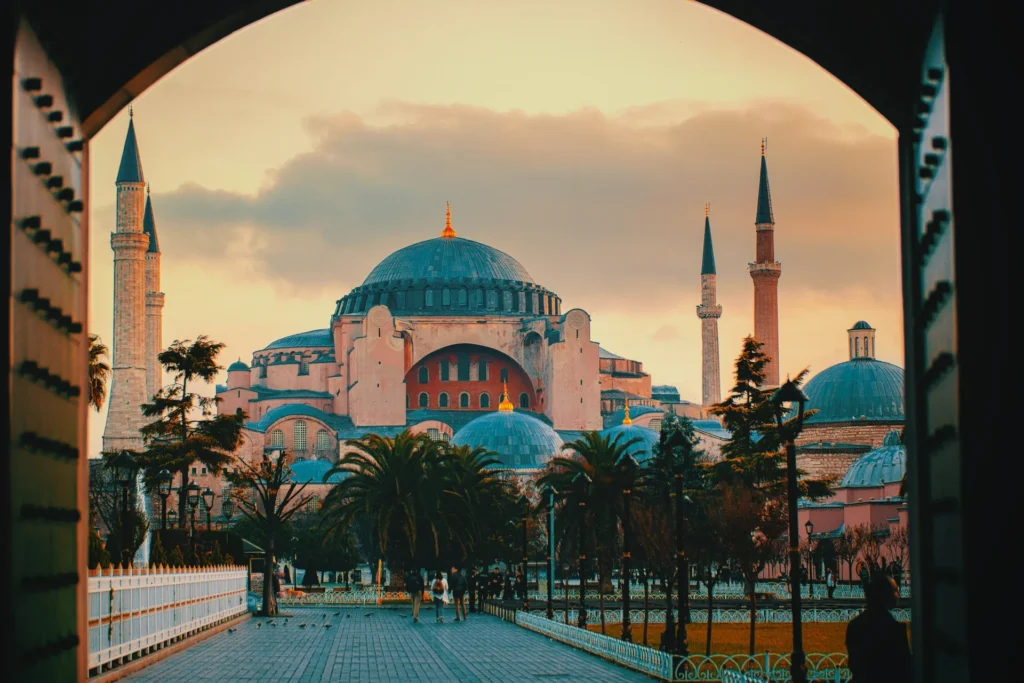
Hagia Sophia, meaning “Holy Wisdom,” stands as one of the world’s most magnificent architectural marvels and a living testament to Istanbul’s rich cultural tapestry. Built between 532-537 AD by Byzantine Emperor Justinian I, this extraordinary structure served as the world’s largest cathedral for nearly a thousand years before its conversion into a mosque following the Ottoman conquest of Constantinople in 1453.

Designed by the brilliant Greek architects Anthemius of Tralles and Isidore of Miletus, Hagia Sophia revolutionized architecture with its innovative engineering techniques, particularly the use of pendentives to support its massive central dome. The dome, spanning 31 meters in diameter and soaring 55.6 meters high, appeared to float miraculously above the vast interior space, inspiring countless architectural wonders including the Blue Mosque across Sultanahmet Square.

The building’s interior showcases an extraordinary fusion of Byzantine and Islamic art, where ancient Christian mosaics depicting emperors, saints, and religious scenes coexist with magnificent Islamic calligraphy and geometric patterns. After the Ottoman conquest, rather than destroying this architectural masterpiece, Sultan Mehmed II chose to preserve its structural integrity while adding Islamic elements including minarets, a mihrab, and minbar, creating a unique synthesis of two great civilizations.

Following various transformations throughout history, Hagia Sophia served as a museum from 1935 to 2020 under the secular Turkish Republic, before being reconverted to an active mosque. Today, this UNESCO World Heritage site continues to captivate millions of visitors with its breathtaking mosaics, including the famous Deësis mosaic, the Virgin Mary and Christ Child in the apse, and imperial portraits that offer glimpses into 1,500 years of Byzantine and Ottoman history.

Located in the heart of Sultanahmet Square, directly opposite the Blue Mosque and near Topkapi Palace, Hagia Sophia remains not only an active place of worship but also a powerful symbol of cultural continuity, religious tolerance, and architectural genius that has influenced building design across the world for over 1,400 years.

Interesting Facts

Built in just 5 years (532-537 AD) under Emperor Justinian I, using innovative mathematical and engineering principles that revolutionized architecture.
The massive central dome has a diameter of 31.8 meters and rises 55.6 meters high, remaining the largest dome in the world for nearly 1,000 years until the Florence Cathedral.
Emperor Justinian reportedly declared upon its completion "Solomon, I have outdone thee!" comparing it to the legendary Temple of Solomon.
Served as the coronation site for Byzantine emperors for over 900 years, with the omphalion (circular marble floor design) marking the exact spot where emperors were crowned.
During the Fourth Crusade (1204), it briefly became a Latin Catholic cathedral, and Enrico Dandolo, the Doge of Venice, was buried within its walls.
The great Ottoman architect Mimar Sinan, who built the Süleymaniye Mosque, also worked to repair and strengthen Hagia Sophia during the reign of Sultan Selim II.
Contains mosaics made with gold, silver, glass, terra cotta and colorful stones, with plant-based and geometric mosaics from the 6th century and figured mosaics from the post-Iconoclastic period.
Influenced architectural design worldwide, directly inspiring Russian Orthodox churches in Moscow and Kiev, as well as Ottoman mosques throughout the empire.

Visitor Information

Opening Hours

Daily: 09:00 AM - 07:30 PM Closed to tourists Friday: 12:00 PM - 02:30 PM (for congregational prayers) Open for Muslim worshippers 24/7 Last entry for tourists: 06:30 PM

Entrance Fee

€25 (approximately 750 TL) for upper gallery access Children under 8: Free

Recommended Duration

5 minutes to 1 hour for self-guided visit 1-1.5 hours with guided tour

Best Time to Visit

Early Morning, Late Afternoon, Weekdays, Winter

Address

Sultan Ahmet, Ayasofya Meydanı No:1, 34122 Fatih/İstanbul, Turkey Located in Sultanahmet Square, directly across from the Blue Mosque

Location & Map

Loading map...

Frequently Asked Questions

Hagia Sophia is special as one of the world's greatest architectural achievements, representing nearly 1,500 years of history in a single building. Its revolutionary dome design changed architectural history, while its unique status as a structure that has served as both Christian cathedral and Islamic mosque makes it a powerful symbol of cultural synthesis. The building houses extraordinary Byzantine mosaics alongside Islamic calligraphy, creating a visual dialogue between two great civilizations. Its massive dome was an engineering marvel that inspired countless buildings worldwide, from Orthodox churches to Ottoman mosques.
bsolutely! Hagia Sophia offers an unparalleled experience combining architectural genius, historical significance, and artistic treasure in one extraordinary location. As a UNESCO World Heritage site, it showcases some of the world's finest Byzantine mosaics, innovative engineering, and 1,400 years of continuous use. The building's unique history as church-turned-mosque provides insights into the cultural evolution of Istanbul and the broader Mediterranean world. Despite the entrance fee, the experience of standing beneath its soaring dome and witnessing the layers of history is unforgettable.
Hagia Sophia is located in Istanbul, Turkey's largest city and former capital of both the Byzantine and Ottoman empires. Istanbul sits at the crossroads of Europe and Asia, straddling the Bosphorus Strait in northwestern Turkey. The city has been a major cultural and political center for over 2,000 years, making it the perfect setting for this monument that bridges East and West, Christianity and Islam, ancient and modern worlds.
Hagia Sophia is located in the heart of Istanbul's historic Sultanahmet district, at Sultan Ahmet, Ayasofya Meydanı No:1, 34122 Fatih. It sits prominently in Sultanahmet Square, directly across from the Blue Mosque and within walking distance of Topkapi Palace, the Basilica Cistern, and the Grand Bazaar. The location is easily accessible by tram (T1 line to Sultanahmet station), metro, bus, or taxi, making it the perfect starting point for exploring Istanbul's UNESCO World Heritage historic peninsula.
Yes, Hagia Sophia is currently open daily from 9:00 AM to 7:30 PM for tourist visits to the upper gallery. However, it's closed to tourists on Fridays from 12:00 PM to 2:30 PM for congregational prayers. As an active mosque, the ground floor is reserved for worshippers, while tourists can access the upper gallery where the most significant mosaics and historical features are located. The building is also open 24/7 for Muslim worshippers wishing to pray.
No, Hagia Sophia is not free to enter for tourists. As of 2025, there is an entrance fee of €25 (approximately 750 TL) for access to the upper gallery where tourists can view the mosaics and historical features. Children under 8 enter free.
Yes, visitors can see remarkable Byzantine Christian mosaics in the upper gallery, including the famous Deësis mosaic showing Christ with the Virgin Mary and John the Baptist, imperial portraits, and the Theotokos (Virgin Mary and Christ Child) in the apse. However, access is now limited to the upper gallery only, and many ground-level mosaics are not visible to tourists. The most significant mosaics survived because they were covered with plaster during the Ottoman period and were uncovered during 20th-century restoration work.
Yes, since Hagia Sophia is an active mosque, all visitors must follow Islamic dress code requirements. Both men and women must cover shoulders, arms, and knees. Women must also cover their hair with a headscarves (available for purchase at the entrance for 50 TL if needed). All visitors must remove shoes before entering. Modest, respectful clothing is essential, and visitors should be prepared to show respect for worshippers and the sacred nature of the space.
Visit early morning right after opening (9:00 AM) or late afternoon before closing on weekdays for fewer crowds. Avoid Fridays when the mosque is closed to tourists from 12:00-2:30 PM, and weekends when both tourist and worshipper numbers peak. Winter months (November-March) generally see fewer tourists than the peak summer season. The new entrance fee and regulated access have reduced overcrowding compared to previous years.
Istanbul is famous for being the world's only transcontinental city, spanning Europe and Asia across the Bosphorus Strait. The city is renowned for its extraordinary historical sites including Hagia Sophia (a former church and mosque), the Blue Mosque with its six minarets, and Topkapi Palace where Ottoman sultans ruled for centuries. Istanbul is famous for its vibrant bazaars - the Grand Bazaar (one of the world's oldest covered markets) and the aromatic Spice Bazaar. The city is celebrated for exceptional Turkish cuisine including kebabs, baklava, Turkish delight, and Turkish coffee. Istanbul is known for its rich cultural heritage blending Byzantine, Ottoman, and modern Turkish influences. The city is famous for stunning architecture, scenic Bosphorus cruises, traditional Turkish baths (hammams), and vibrant nightlife. As a former capital of both Byzantine and Ottoman empires, Istanbul is famous for its 2,700 years of continuous history and its role as a bridge between East and West, Christianity and Islam, tradition and modernity.
Istanbul is located in northwestern Turkey, uniquely positioned as the only city in the world that spans two continents - Europe and Asia. The city straddles the Bosphorus Strait, which connects the Black Sea to the Sea of Marmara. The European side (Thrace) contains the historic Old City with major attractions like Hagia Sophia and Topkapi Palace, while the Asian side (Anatolia) features more residential areas and modern districts. Istanbul is situated at approximately 41°N latitude and 29°E longitude. The city is bordered by the Golden Horn inlet to the north and the Sea of Marmara to the south. This strategic location has made Istanbul a crucial crossroads between Europe and Asia for over 2,500 years, controlling vital trade routes and serving as a bridge between different cultures, religions, and civilizations.
Yes, Istanbul and Constantinople are the same city. Constantinople was the historical name used from 330 AD to 1930, while Istanbul is the modern name. The city was originally founded as Byzantion by the Greeks, then renamed Constantinople by Roman Emperor Constantine I in 330 AD, meaning "City of Constantine." After the Ottoman conquest in 1453, the city was often called Kostantiniyye in Ottoman Turkish, though locals had long used variations of "Istanbul." The name Istanbul officially became the sole name in 1930 when the Turkish Republic mandated its use. So this magnificent city has had three main names throughout its 2,700-year history, but it has always been the same strategic location bridging Europe and Asia.
Istanbul (then Constantinople) was conquered by the Ottoman Empire on May 29, 1453. This historic conquest was led by 21-year-old Sultan Mehmed II, earning him the title "Mehmed the Conqueror." The 55-day siege began on April 6, 1453, and ended with Ottoman victory on May 29. This conquest marked the end of the Byzantine Empire after more than 1,000 years and represented a major turning point in world history. The date May 29, 1453, is considered one of the most significant dates in both Turkish and world history, as it established Ottoman control over this strategic city and transformed it into the capital of the growing Ottoman Empire. The conquest opened the door for Ottoman expansion into Europe and established Istanbul as one of the world's great imperial capitals.
Absolutely yes - Istanbul is one of the world's must-visit destinations! This unique city offers an unparalleled travel experience as the only city spanning two continents. You'll discover incredible historical sites like Hagia Sophia, Blue Mosque, and Topkapi Palace, explore vibrant bazaars like the Grand Bazaar and Spice Bazaar, and enjoy world-class cuisine from Turkish delights to kebabs. The city combines rich history with modern culture, offering everything from Byzantine churches and Ottoman mosques to contemporary art galleries and rooftop bars. Affordable prices, warm hospitality, and stunning Bosphorus views make Istanbul perfect for all types of travelers. Whether you're interested in history, culture, food, or architecture, Istanbul delivers an unforgettable experience that justifies its position as one of the world's top tourist destinations.
When visiting Istanbul, avoid these common pitfalls: Don't fall for tourist scams like overpriced shoe-shining tricks or fake police demanding to see your wallet. Avoid unlicensed taxis - use official yellow taxis, Uber, or BiTaksi instead. Don't buy from aggressive street vendors around major attractions who often overcharge tourists. Avoid revealing clothing when visiting mosques - bring a scarf and wear long pants. Don't drink tap water - stick to bottled water. Avoid political discussions and demonstrations. Don't change money on the street - use official exchange offices or banks. Avoid walking alone late at night in less touristy areas. Don't photograph military installations or security personnel. Avoid rush hour traffic (7-10 AM, 5-8 PM) when planning transportation. Finally, don't skip travel insurance and always keep copies of important documents separate from originals.