Photo Gallery
21 Photos
Click on any image to view in full size
About This Attraction
Topkapı Palace served as the main residence of Ottoman sultans and the administrative center of the Ottoman Empire from the 1460s until the completion of Dolmabahçe Palace in 1856. Construction was ordered by Sultan Mehmed the Conqueror in 1459, six years after the conquest of Constantinople, with the initial phase completed between 1460-1478. The palace represents one of the most significant examples of Ottoman civil architecture, demonstrating the power and sophistication of the empire at its height.
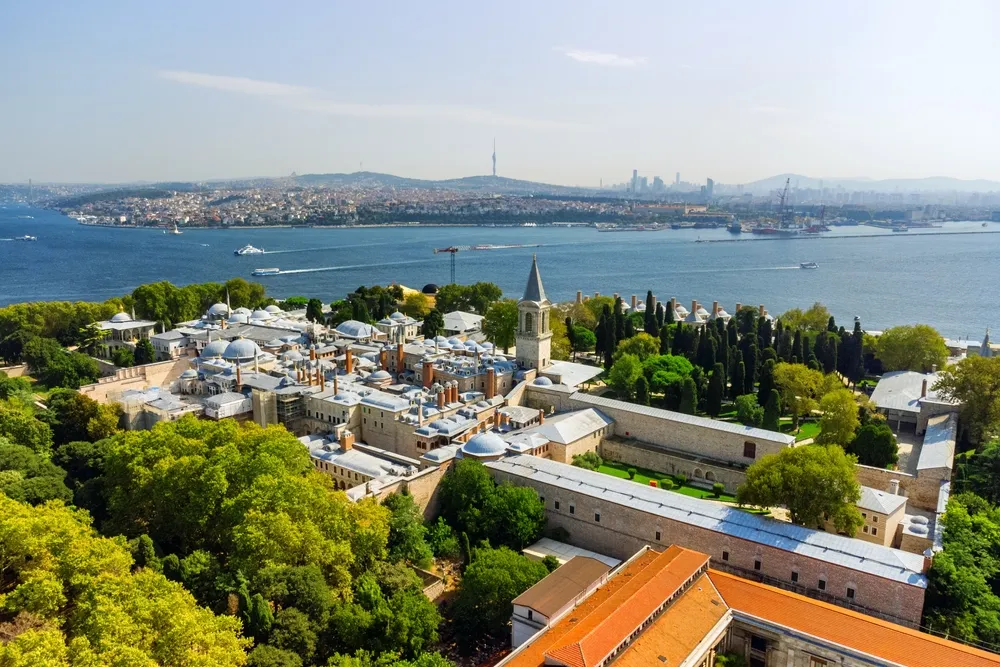
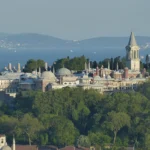
Located on the Seraglio Point (Sarayburnu), a promontory overlooking the Golden Horn where the Bosphorus Strait meets the Sea of Marmara, the palace sits at one of the highest points close to the sea. During Greek and Byzantine times, the acropolis of the ancient Greek city of Byzantion stood here. This strategic position allowed sultans to control both maritime traffic through the Bosphorus and overland approaches to the city, while also providing breathtaking views that emphasized imperial authority over this crucial crossroads between Europe and Asia.
Unlike other European palaces, which feature one large building with outlying gardens, Topkapı is a series of pavilions, kitchens, barracks, audience chambers, kiosks and sleeping quarters built around a central enclosure. The palace consists of four consecutive courtyards surrounded by high walls, with each courtyard serving different purposes and separated by gates that incrementally restricted entry. This architectural approach reflected Ottoman concepts of power hierarchy and privacy, with the innermost courtyards reserved for the sultan and his immediate household.
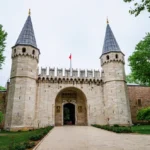
The First Court served as a public space where anyone could enter during daylight hours, bustling with state officials, soldiers, and petitioners. The Second Court, accessed through the imposing Gate of Salutation, contained the imperial kitchens that could prepare meals for thousands daily, along with the Divan (Imperial Council) chamber where the sultan’s viziers administered the empire. The Third Court housed the sultan’s private quarters and the famous Treasury, which today displays an extraordinary collection of imperial regalia, jeweled weapons, and ceremonial objects including the 86-carat Spoonmaker’s Diamond.
About 30 sultans ruled from Topkapı Palace for nearly four centuries during the Ottoman Empire’s 600-year reign, with the palace housing 1,000–4,000 inhabitants, including up to 300 in the harem. The palace experienced significant expansion after Sultan Suleiman‘s wife, Hürrem Sultan, decided to permanently move the Ottoman Imperial Harem to Topkapı Palace in 1541, breaking established customs. This controversial decision fundamentally changed palace life and politics, as the harem became a powerful center of influence where the sultan’s mother, wives, and concubines wielded considerable authority over succession and state affairs.
The Imperial Harem represents one of the palace’s most fascinating sections, containing over 300 rooms arranged around courtyards and corridors. Contrary to Orientalist fantasies, the harem functioned as the private family quarters of the sultan, following strict protocols and hierarchies. The Valide Sultan (queen mother) occupied the most powerful position, often serving as the de facto ruler when her son was young or inexperienced. The harem’s intricate social structure, education system, and living arrangements demonstrate the sophisticated organization that governed Ottoman court life.
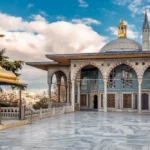
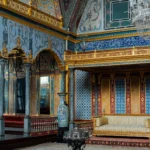
The palace architecture showcases influences from Byzantine traditions, Persian aesthetics, and Islamic geometric patterns, creating a uniquely Ottoman synthesis. Elaborate Iznik tiles decorate walls throughout the palace, featuring intricate floral designs in brilliant blues, turquoises, and reds. The Baghdad Kiosk and the Revan Kiosk exemplify the refined artistry of 17th-century Ottoman architecture, with their domed interiors covered in precious tiles and mother-of-pearl inlay work.
The palace officially “retired” in 1856, when Sultan Abdülmecid moved the entire imperial court to the newly built Dolmabahçe Palace on the Bosphorus shore. Topkapı’s traditional architecture was considered outdated compared to the European-style grandeur of the new palace, reflecting the Ottoman Empire’s attempt to modernize and compete with Western powers. After the fall of the Ottoman Empire in 1922, Mustafa Kemal Atatürk ordered Topkapı to become a museum, opening to the public in April 1924 as one of the first major museums of the new Turkish Republic.
Today, Topkapı Palace Museum attracts millions of visitors annually, offering an unparalleled glimpse into Ottoman imperial life spanning four centuries. The palace complex covers approximately 700,000 square meters, with its museums displaying an extraordinary collection of Islamic calligraphy, miniature paintings, religious relics, imperial costumes, weaponry, and royal treasures. Visitors can explore the legendary Topkapı Dagger encrusted with emeralds, sacred Islamic relics including what’s believed to be Prophet Muhammad‘s cloak and sword, and countless other artifacts that chronicle the rise and reign of one of history’s greatest empires.
Interesting Facts
Visitor Information
Opening Hours
Entrance Fee
Recommended Duration
Best Time to Visit
Address
Cankurtaran, 34122 Fatih/Istanbul, TurkeyLocation & Map
Tip: Click and drag to explore the map, use scroll wheel to zoom in/out